
MLFlow-Based Model Registry & Training Platform
CLI-first ML platform built on MLflow enabling experiment tracking, reproducibility, and seamless model promotion across environments.
Tech Stack
Aim
To create a single source of truth for ML development, enabling reproducibility, traceability, and scalable retraining workflows.
Architecture
Objectives
Centralise model development
Unify experiments, models, and artifacts into one governed platform.
Improve traceability
Track full lineage of models including data, params, and code.
Enable reproducibility
Ensure models can be recreated reliably across environments.
Accelerate iteration
Reduce duplication and enable reuse of validated components.
Simplify collaboration
Provide shared tooling for data scientists and engineers.
Support scalability
Enable CI/CD, governance, and monitoring foundations.
Implementation
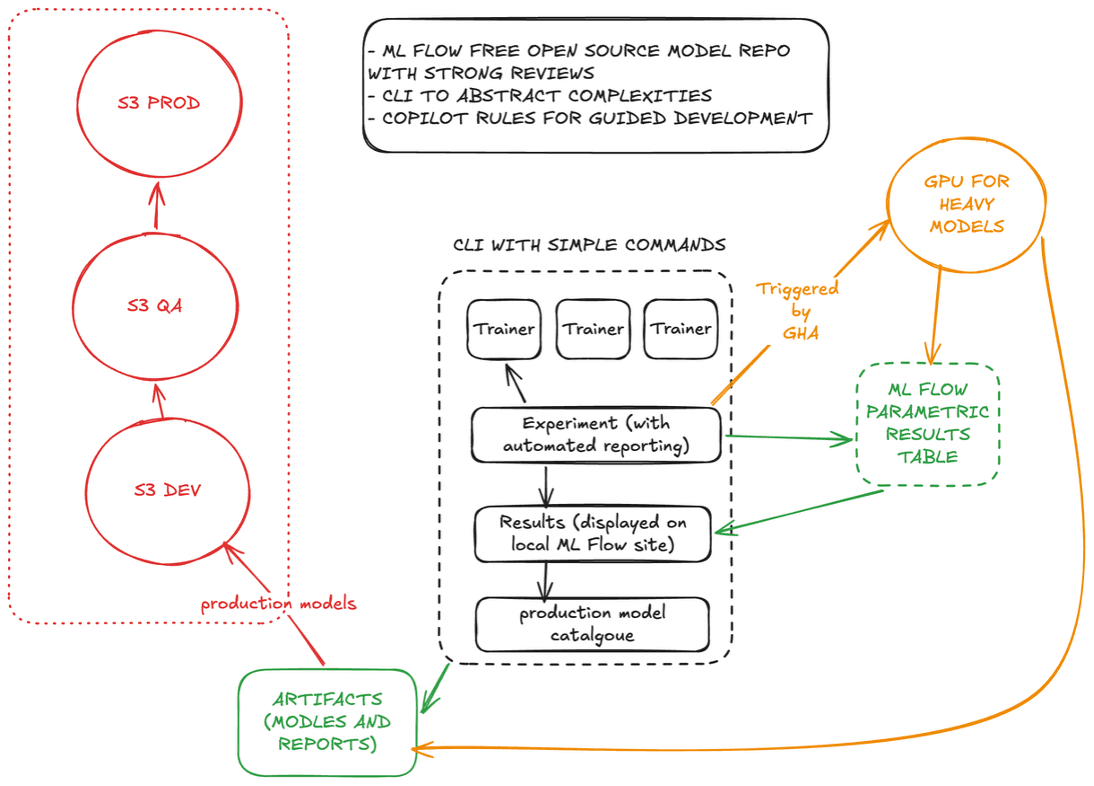
- Designed CLI-first workflow to abstract MLflow complexity
- Built experiment pipeline with automated reporting and logging
- Integrated MLflow tracking + parametric results table
- Implemented S3 environment separation (dev → QA → prod)
- Enabled GPU-triggered training for heavy models via CI
- Created production model catalogue from experiment outputs
Key Highlights
- Solved ML experiment tracking fragmentation by centralising everything in MLflow registry
- Introduced CLI-first workflow that dramatically improved developer experience
- Enabled fully reproducible training pipelines across dev, QA, and production environments
- Reduced operational friction through automated experiment logging and model promotion
- Improved scalability by integrating CI-triggered GPU training workflows
Impact
- Faster model iteration cycles
- Increased number of production-ready models
- Improved cross-team understanding of model performance
- Stronger governance and auditability of ML systems
Key Takeaways
- CLI abstraction dramatically improves developer experience
- Strict experiment tracking is critical for production ML
- Separation of environments prevents model leakage
- Incremental platform adoption reduces organisational friction